Game Design 101 - Intellectual Production #8
In her book, Game Design Workshop, Tracy Fullerton suggests a variety of exercises to encourage game designers to reflect and push their thinking about what games can be. Below I've chosen 5 exercises to work through.
Exercise 1.3 - Your Life as a Game
List five areas of your life that could be games.Then briefly describe a possible underlying game structure for each.
Walking my dog
The first area of my life is an activity I engage in multiple times a day that I think would be a fun game because of its unpredictability. Walking my dog is always lots of fun, and depending on different environmental factors (squirrels, other dogs, rain, snow, etc) the experience can vary greatly. There are a few underlying structures that would contribute to making this a fantastic game. First, the parameters in which the dog walker ("player") must play within. The player needs to obey traffic rules, and stay on the sidewalk, this creates the boundaries of play. Next, there are unexpected obstacles for the player to avoid or interact with, such as squirrels or rabbits that my dog likes to attempt to run after. There are also the small interactions and relationships with other dog walkers that make the experience more interesting, such as being told about new trails or paths for the player and their dog to discover.
Driving
Just like walking my dog, I think driving has some interesting underlying game structures. Driving involves having very clear goals, usually when you get behind the wheel you have a clear idea of where you are going and how you plan to get there. This gives the player a goal that they are aiming for to achieve “success”, but the journey itself isn’t always so straight forward. There are a lot of parameters that the player needs to play within, such as following all traffic laws and staying on the road to avoid being arrested. It is also a game of anticipating the moves of other players. Although there are other players in this game, it is not a zero sum game, you need to work with other players cooperatively so that all players can achieve their goals and reach their destinations on time and safely. I think the last structure that really adds to driving being a good game is the time aspect. When you’re driving somewhere (such as work, or an appointment), there is often a time constraint to reach your destination on time. This adds an extra layer of pressure to the player and creates a problem solving challenge to choose the right route to ensure they make it on time.
Grocery Shopping
Although this is not a task I’m particularly fond of, it is one that I perform weekly. Grocery shopping involves a lot of different game mechanics that could make it lots of fun. You begin this journey with an idea of what you’re looking for, often written on a grocery list, and this provides you with a clear goal in order to “win” the game. Depending on the grocery store you are at the location of certain items can change (I’m thinking of a place like Costco), and this presents the player with a puzzle that they need to solve, while avoiding or interacting with obstacles along the way. Once the player finds all of the items on their list they need to take it up to the cash register and ensure that they have the funds to pay for them. This can create another game mechanic, where the player has a budget that they need to work within, this may involve extra searching for sales on the items they’re looking for or even searching for coupons before they arrive.
Cooking
Cooking is a very fun activity for me, and is already the inspiration for many games (for example, Overcooked) because it has so many underlying game structures to it. A few of the game structures that makes me believe it would make a good game are a clear set of instructions to follow, lots of moving parts means that lots can go wrong, and the importance of good time management. Although cooking rides the line between an art and a science, there are often clear instructions in the form of recipes that should be followed for a dish to turn out well — you don’t want undercooked pasta — and the player would need to follow these recipes to the best of their ability to provide their family with a delicious meal to limit any complaints. When cooking a large meal, there are often many things on the go at the same time, such as boiling pasta at the same time as cooking the pasta sauce. This brings in two major game components, time management and multitasking. If certain elements of a meal aren’t tended to properly it could result in the player burning portions of the meal and thus ‘losing’ the game. However if they do a good job of following the instructions, tending to the different items and managing their time, they are rewarded with a delicious meal!
Coding
The last part of my life that I believe would make an excellent game is coding. I am a software developer, and a lot of my daily tasks involve programming and problem solving. Software development usually starts by defining a large goal that the player will need to accomplish by breaking it down into smaller challenges that they will need to problem solve. As the player accomplishes some of the smaller challenges at the beginning, there is a natural progression in difficulty. Along the way, different ‘bugs’ pop up and need to be addressed before a task can be considered complete. While the player is navigating their way through all of these different challenges, they really need to be mindful of their time because clients have specific expectations of when software deliverables should be finished, so spending too long fighting off bugs can set the player behind.
Exercise 2.3 - Objectives
List five games, and in one sentence per game, describe the objective in each game.
Mario Kart
Complete the driving course ahead of all other players.
Pokemon
Train your pokemon to become the strongest pokemon trainer in the game.
Just Dance
Follow the onscreen directions at the specified intervals to maximize your score.
Wordle
Guess the word in as few attempts as possible using the hints provided.
Settlers of Catan
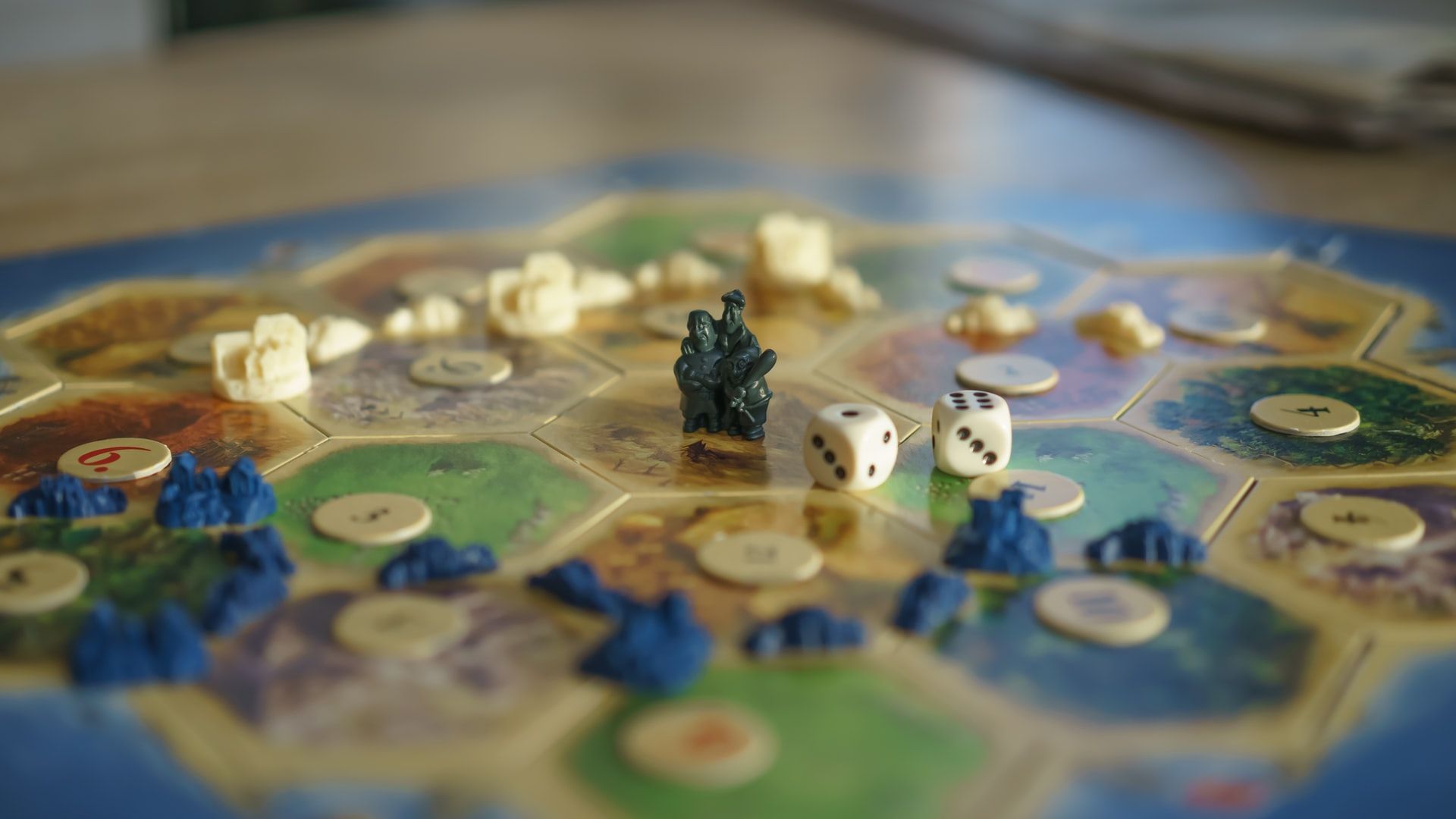
Gather, trade and use resources to build roads and settlements to be the first to reach 10 victory points.
Exercise 2.4 - Rules
Can you think of a game that has no rules? If so, describe it. How about one rule? Why is this exercise difficult?
This was an incredibly difficult task, and one that I’m not sure I’ve accomplished. Legend of Zelda: Breath of the Wild is a game that comes to mind that has few rules. It is an open world game that allows the player to explore, cook, start fires, fight enemies, etc. and although there are goals for the player to achieve, you don’t directly have to accomplish them. The player can wander around the map, along the way encountering challenges and puzzles for them to accomplish, but there is very little structure to how a player progresses through the levels.
One rule that comes to mind is if you lose all of your hearts your character dies. I think this exercise was especially difficult because in one way or another all games have rules. Although some games have very specific sets of rules, all games require rules to form the basic parameters for a player to play within.
Exercise 3.11 - Boundaries
What are the boundaries in the tabletop role-playing game Dungeons & Dragons? Can you think of physical and conceptual boundaries?
Players determine much of the boundaries in the role-playing game Dungeons and Dragons. Before beginning the game, a player describes their character’s strengths and weaknesses, which determines the conceptual boundaries for that specific character. Players then make the decision whether or not they will be playing the game or just observing. The game takes place on the table that players are sitting around, and the board and obstacles are determined by the Dungeon Master, which can set a physical barrier for the players to travel within. Another physical barrier is the dice that it is played with, typically a 20 sided die, setting the boundary that players can only roll a number between 1 and 20.
Exercise 3.12 - Outcomes
Name two zero-sum games and two non-zero-sum games.What is the main difference in the outcomes of these games? How does this affect gameplay?
Fullerton describes a “zero-sum” game as one in which a win can be considered a +1 and a loss a -1, meaning the sum of any outcome remains at a zero (Fullerton 2014). Risk is a good example of a zero sum game. The objective of the game is for the player to conquer and control all countries on the board. It is extremely competitive in nature, pitting players against each other in a simulated arms race. This means that anytime a player conquers another player’s land they gain a country (+1) and another player loses a country (-1), resulting in a sum of zero. As a player begins to achieve success in conquering other players' countries it starts a snowball effect that helps them to continue along their route to victory. This is very similar to the popular board game Monopoly, where players compete to capture as much money as they can and the more they acquire the easier it becomes for them to continue their success. However, based on the definition of zero sum, Monopoly would not be considered a zero sum game. The reason for this is that each win that a player achieves does not result in the loss of another player, leaving the outcome as more or less than a sum of zero. Monopoly is a very complex game that can result in many players gaining or losing money or properties in ways that other players are unaffected by. For example, if a player draws a chance card that requires them to pay a tax on every property they own (-1), it does not benefit other players directly (0), creating a negative sum. This allows players to achieve different levels of success throughout and extends the gameplay lifespan.
Not all games require one player to win and another to lose in order to be considered a zero sum. One example that comes to mind is Magic Maze. In this board game players must work together to collect all of the required items and then navigate the game pieces to the exits to be successful. I would argue that the opponent in this scenario is the board, and a win from all the players results in a loss for the board and vice versa, creating a zero sum when tallying wins and losses. This creates a very competitive environment for the players to work together in. Contrasting this might be Cards Against Humanity, where players are competing to make each other laugh through absurd card combinations determined by the luck of their hand. Although a player is able to win by being the first to collect 7 black cards, others didn’t lose a black card in order for them to gain one. Players are able to rank themselves based on the number of cards they collected in relation to one another, creating a gradation system. Strategy is important here, however a lot of the game is often determined by the chance of their drawn cards, rather than direct strategy against other players. This creates a gameplay that is more cooperative in nature than it is competitive.
References
Fullerton, T. (2014). Game Design Workshop: A Playcentric Approach to Creating Innovative Games, NY: Taylor & Francis (CRS Press)/ Chapters 1, 2, 3.