The Emotional Robot
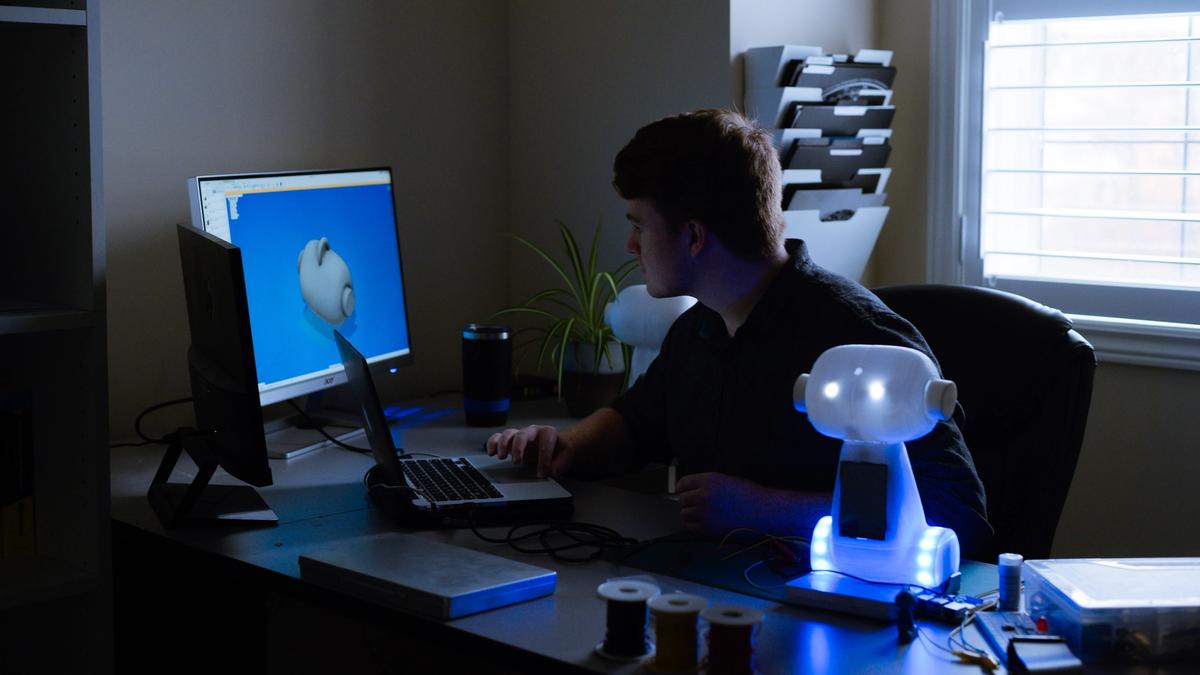
The Emotional Robot was my undergraduate thesis project, built between September 2017 and May 2018. It began as an open research question: how can new and emerging technologies augment the communication and self-regulation skills of students with autism? I explored several methods in an attempt to answer it, iPad applications, games, and virtual reality, and ultimately landed on something physical and tactile. A friendly robot character a child could hold, carry, and keep with them. The finished robot ran on a Raspberry Pi 3 with a camera in the head, an accelerometer and supporting sensors in the body, and a screen in the torso. Its ears were potentiometer knobs, so a child navigated the screen by turning them rather than tapping glass. The screen served multiple purposes depending on need: picture symbols for communication, guided breathing exercises, music, and videos. The camera read the child's facial expression and, based on the predicted emotional state, offered a self-regulation strategy suited to the moment. Every part of this process was new to me. I taught myself how neural networks worked in order to train an emotion classification model in TensorFlow. I taught myself Fusion 360 to design the shell, and bought an inexpensive 3D printer so I could iterate quickly on forms that would survive a seven-year-old. The project was presented at GradEx in May 2018.
The Problem
Neurodiverse individuals often rely on analog tools (like physical PECS cards or visual timers) that don't seamlessly transition between different environments like home, the classroom, and recess. There was a need for a unified, portable support system that could proactively assist with self-regulation and communication, ensuring children have consistent access to the behavioural supports they need without relying entirely on constant adult intervention.
The Solution
"The Emotional Robot" is an interactive, responsive companion that bridges these environments. By integrating a multi-purpose digital interface with computer vision and physical sensors, it digitizes essential support mechanisms while introducing proactive emotional regulation and empathy-building exercises that translate to improved peer-to-peer interactions.